Data centers in space
Include power, cooling, links, launch and end of life. One local advantage does not prove that the whole system is better.
Links containing ?t= open the video at a specific second.
The ideas to retain
Contents
1. Why now
AI compute demand has increased roughly 350,000× since 2014, while electricity scenarios are already forcing an infrastructure conversation (Chapter 1). Six terrestrial bottlenecks recur:…
2. Energy, heat and connectivity
Why "space is cold" does not mean free cooling: heat rejection still dominates and radiator area grows quickly (Chapter 2). A real advantage is longer-duration solar exposure in suitable…
Jump directly to a section
Read the reviewed transcript
Transcript of the visual text. This video has no narration.
00:00 — Moving compute changes the constraints.
A server needs power, a way to reject heat and communication.
Moving it into orbit changes the paths supporting all three functions.
The question is not just whether it works, but which task justifies it.
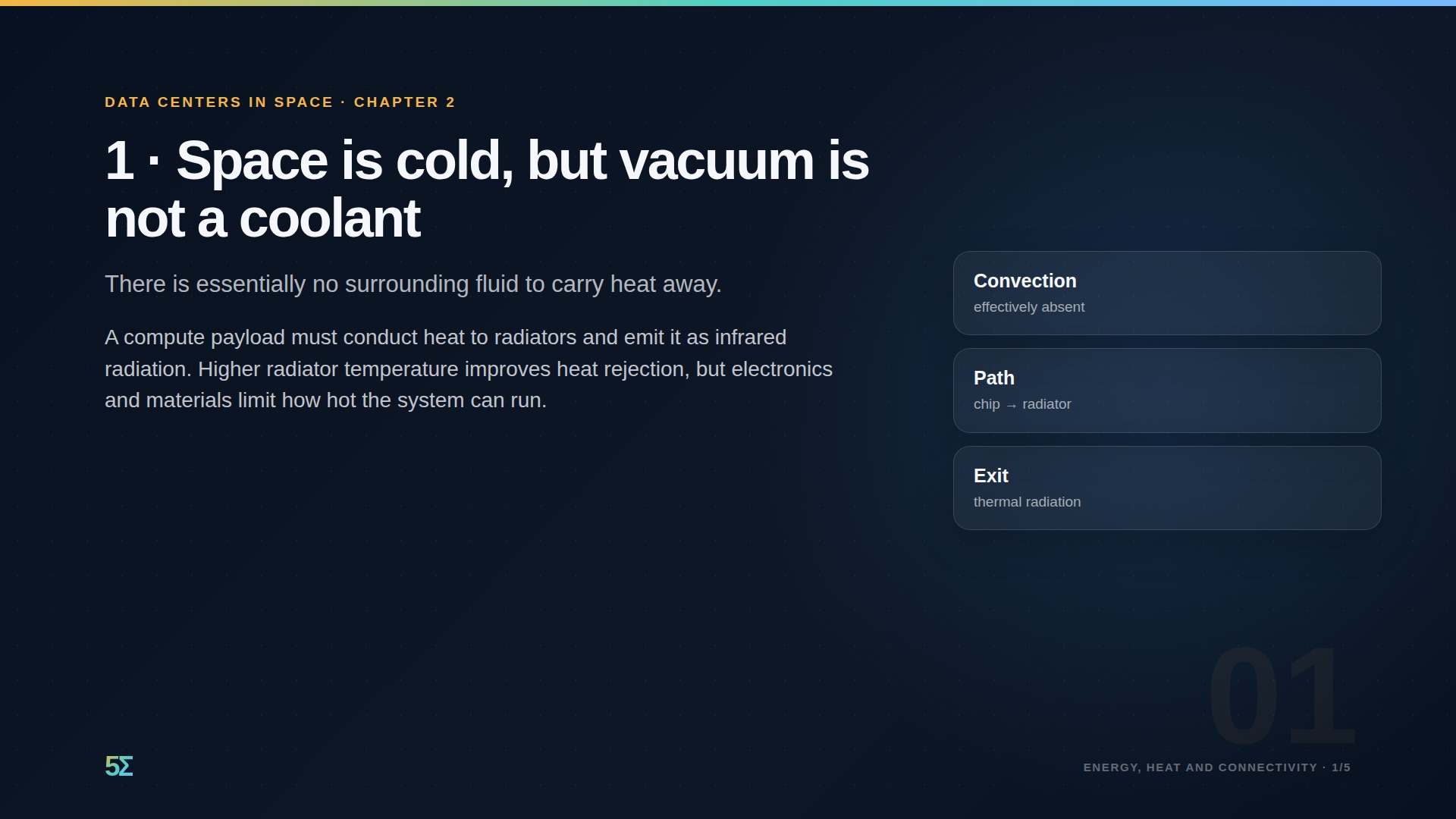
00:22 — Cold surroundings do not carry heat away.
On Earth, air or water can carry heat away.
In the outside vacuum, no air flows through the server.
Heat must reach a surface that radiates it into space.
00:44 — Solar energy depends on the orbit.
Above the atmosphere, a panel avoids atmospheric absorption.
But an orbit can cross Earth’s shadow and lose sunlight.
Compare useful energy over the mission, not just power in sunlight.
Illustrative example; assumptions, not operational measurements.
01:06 — Process before transmitting.
An orbital sensor can produce more data than it can send.
When the task allows it, process onboard and transmit a smaller result.
The reduction must preserve the information needed for that task.
Illustrative example; assumptions, not operational measurements.
01:28 — A demonstration is not a service at scale.
Running one device demonstrates that test under its conditions.
More devices also need more power, heat rejection and communication.
Reliability at a larger scale needs evidence of its own.
Illustrative example; assumptions, not operational measurements.
01:50 — Compare the system. Not one advantage.
Hold the task and required service level constant.
Include power, cooling, links, launch and end of life.
One local advantage does not prove that the whole system is better.